
By Owen Quinn author
If you’re have an idea for a historical adventure or going to do an autobiography on some celebrity then the one thing you must do is research. Fact checking in multiple sources is important especially when writing someone’s life story. That celebrity may have many fans and they will be the first ones to kick off if you write something in error about their hero. That is why so many people love a good nitpick at other’s work.
Look at movies; I love those guys that scrutinise and pick out the continuity errors and bloopers. But they also love to correct facts about events that have happened. You must treat your story in exactly the same way. A story/book is a product you want to sell to people; you want them to go away as fans of your work because they will return for more. Now nobody is perfect and there are some typos that get past even the best of editors which sometimes actually add to the value of the book. But you want to avoid that after all, you wouldn’t sell someone a faulty kettle.
Now research can cover so much. Everything that has happened before today is historical therefore can be detailed and studied on the net.
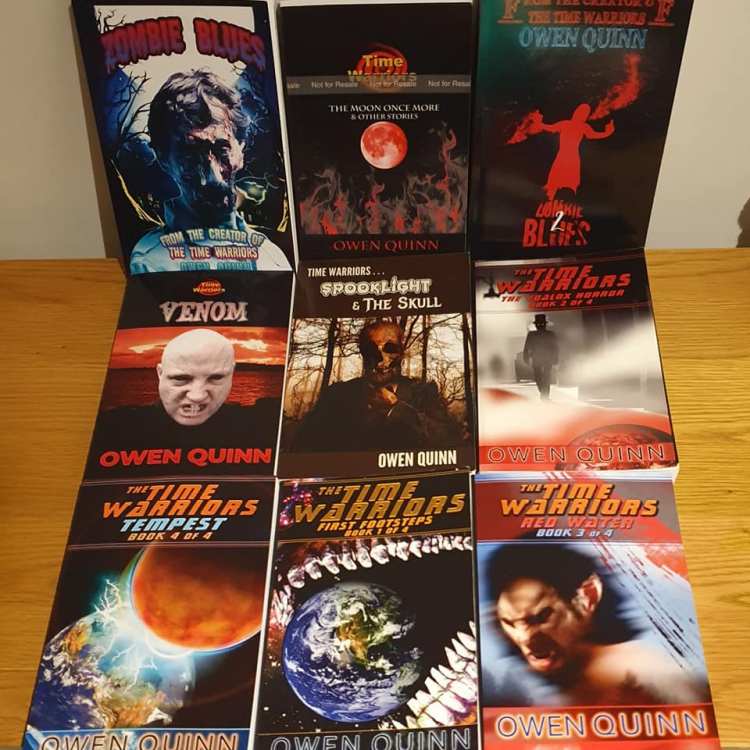
Let’s take one of mine. Summer’s End is part of The Time Warriors: Book 3 Red Water.
That adventure is set at the time of ancient Celts who celebrated Halloween which was known then as Samhain. I could have thrown caution to the wind and made everything up but I like to have an authenticity to these types of stories especially since the arachnid villains the Mentara were to play a huge part in it. Indeed the more I looked at that period it became clear very quickly that an alien species fitted right in with the beliefs of the Celts.
As you know the veils between the land of the living and the land of the dead drops at Samhain allowing the spirits of those who have passed to return to the Earth for one solitary night. I wanted druids to be involved guarding a secret and give you a taste of life back then. While I got what I wanted about Celtic life and beliefs, I found out so much more that enhanced elements of the story no end.
I discovered that people with white hair were honoured among the Celts and welcomed, which gave me a way in with Varran. I discovered that bonfires were fuelled by animal carcasses to disguise the scent of humans from demons that came across when the veil fell. Those demons allowed me to enter the Mentara seamlessly to the story through their portal. And I discovered a very special shield kept the walls between this world and the next securely apart I made it part of the druid’s secret history. All of these accidental discoveries makes Summer’s End one of my favourites to this day and hopefully one of yours.

Now I included how Celts dressed, the layout of their villages and dietary needs of that era. These are small yet vital details to help the reader visualise in their heads what you are writing about. Your job as a story teller is to paint your story vividly in readers’ heads with your words so small details are vital. You want them to smell, taste and see what you see in your head.
Now, while research is a great thing, you have to tell your story as if you haven’t looked up a thing. There is a great temptation to add in everything you’ve learned thinking it will add a lot to the story.
But it doesn’t.
All that does is show the reader you’ve been researching. It throws them out of the story when you info dump history. Use the small details like clothing, diet, habits of the time, buildings and slang of that era. Make it fit your story; make the characters breathe whatever era you’re writing about. Now you don’t need me to tell you that if you’re going to Victorian London, Mary Poppins will sing in your head but try to avoid that. Doctor Who did a running joke with that when Rose trying to “speak” Scottish, Donna, Roman and Graham being all renaissance when he met Shelley and Byron with the 13th Doctor. Of course they had the Tardis translator as everyone in a Pompeii market place spoke cockney and think Donna was speaking Welsh in the season four episode The Fires of Pompeii.
It is fun and was done to great effect in shows like Hercules and Xena, Warrior Princess. They spoke just like we did. This helps the audience identify with the story and characters and helps drive away all the at “Forsooth” and “thee” forced dialogues that we thought they spoke at the time. There’s no problem having a quick look and sprinkling your dialogue so there is a taste of the period but you want the reader to sail through the story without tripping up on forced dialogue. Think Horrible Histories meets any historic Doctor Who episode.
Even with my second book The Time Warriors The Voalox Horror, I went to Victorian London and avoided the Dick Van Dyke element but referenced it. There are some things that are traditional if you do a story set in that era. The pea soup fog is a must, nearly being run over by a horse drawn carriage, prostitutes with big dreams being murdered in alleyways and backstreets and muffins. Again, this one is another favourite of mine. Who can resist the ghost of Jack The Ripper?
Again there’s no harm in that as it is kind of a tradition and like a gangster story there are certain tropes the audience expects. The trick is tempering that expectation by pulling back the elements that make that era to near background status. They are there but never overshadow the main story.
I suppose like religion, research has its good points and bad points. What you must do is temper the temptation to dazzle the reader with how much you’ve learned about whatever era you’re in. The reader won’t be dazzled, they will bogged down with unnecessary trivia. So take a step back from what you learn and utilise the parts that will add to your characters and story rather than be a travel guide to ancient Egypt.
Knowledge is power but the use of that knowledge defines not only the success of your story but how it hooks the readers. Besides, all that information may come in handy one day when you’re on Who Wants To Be A Millionaire.
 The Time Warriors and Beyond